AI · Software · Technology
Three Things to Check First When Choosing a Mac mini or Mac Studio for AI Work
Hello, I’m Meotjin Aewol Nongbu.
When looking for a Mac for AI work, you may wonder whether a Mac mini is sufficient or whether you need to move up to a Mac Studio. In my view, it is better to first decide what tasks you will run on your computer rather than focus on the product name. Today, I’ll organize the selection criteria based on the product lineup announced in fall 2026.
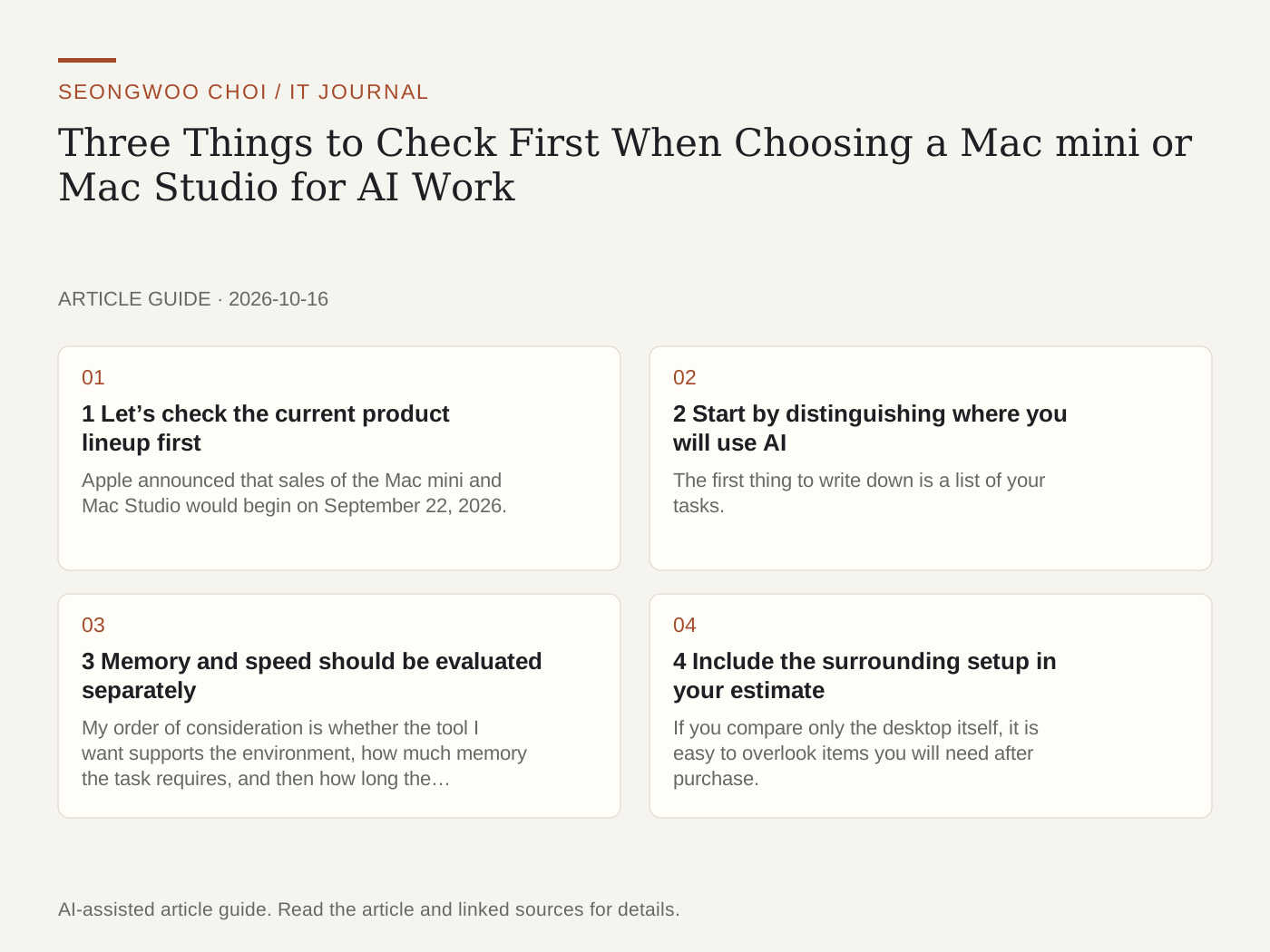
1 Let’s check the current product lineup first
Apple announced that sales of the Mac mini and Mac Studio would begin on September 22, 2026. The Mac mini is offered with the M6 and M5 Pro, while the Mac Studio is introduced with the M5 Max and M5 Ultra.
The maximum unified memory configurations announced in the official release are as follows.
| Product configuration | Maximum unified memory according to the announcement |
| --- | --- |
| Mac mini M6 | 32GB |
| Mac mini M5 Pro | 64GB |
| Mac Studio M5 Max | 128GB |
| Mac Studio M5 Ultra | 512GB |
Apple stated that the 512GB Mac Studio configuration would be available in late October. The maximum capacity does not mean that units with the base specification are immediately available for purchase in every region. Apple official product announcement (https://www.apple.com/newsroom/2026/09/the-new-mac-mini-and-mac-studio-are-available-today/)
2 Start by distinguishing where you will use AI
The first thing to write down is a list of your tasks. The criteria you should compare differ depending on whether you use AI services on the web, call external models through an API, or plan to download model files and run them locally.
For example, someone who organizes documents in a browser and does simple development work and someone who wants to compare several local models are trying to solve different problems, even if they are looking at the same products.
Before buying, write down the three tasks you will do every day and also note what is inconvenient on your current computer. This makes the decision easier than upgrading the specifications simply because the computer is for AI.
3 Memory and speed should be evaluated separately
My order of consideration is whether the tool I want supports the environment, how much memory the task requires, and then how long the processing takes.
The fact that a model runs does not necessarily mean it will deliver the speed you want. When looking at comparison reviews, I also want to check whether the model name and size, quantization method, input length, and software version are the same.
This article does not include inference speeds measured directly or model-specific execution results. The key point is not to read the maximum product specifications as an actual task-performance table.
4 Include the surrounding setup in your estimate
If you compare only the desktop itself, it is easy to overlook items you will need after purchase. It would be helpful to also note the monitor and storage devices you already have, the amount of desk space, and how often you need to move the computer.
If it were me, I would first perform a representative task on my current equipment, record what was inconvenient, and then narrow down the candidates. When seeking purchase advice or reading comparison reviews, asking “What configuration is needed to do this task with this tool?” rather than “Is it good for AI?” is likely to produce a more specific answer.
Do you mainly use AI on the web, or are you also interested in running local models?
Related article: Outlook for Apple’s new products reviewed in the first half of 2026 (https://blog.naver.com/swchoi1994/224240497873) — Please distinguish the outlook at that time from the current official announcement when reading them.
Sources and original article
- www.apple.com/newsroom/2026/09/the-new-mac-mini-and-mac-studio-are-available-today/
- blog.naver.com/swchoi1994/224240497873
Read the Korean original on Naver
This article reflects public information available when it was written. Specifications, prices and schedules can change; check the linked official documentation.
This English edition was written and translated with AI assistance, with sources provided. For errors or additional information, please request a correction. Editorial policy