AI · Software · Technology
Why G42 and Abu Dhabi matter in Microsoft’s Middle East AI investment
Hello, I’m Meotjin Aewol Nongbu.
I previously wrote about how I came to travel from Jeju Island to Abu Dhabi. Today, I’d like to examine changes in the Middle East AI industry connected to that story through public announcements. This article looks at the infrastructure, workforce, and operational foundations announced alongside the investment amounts.
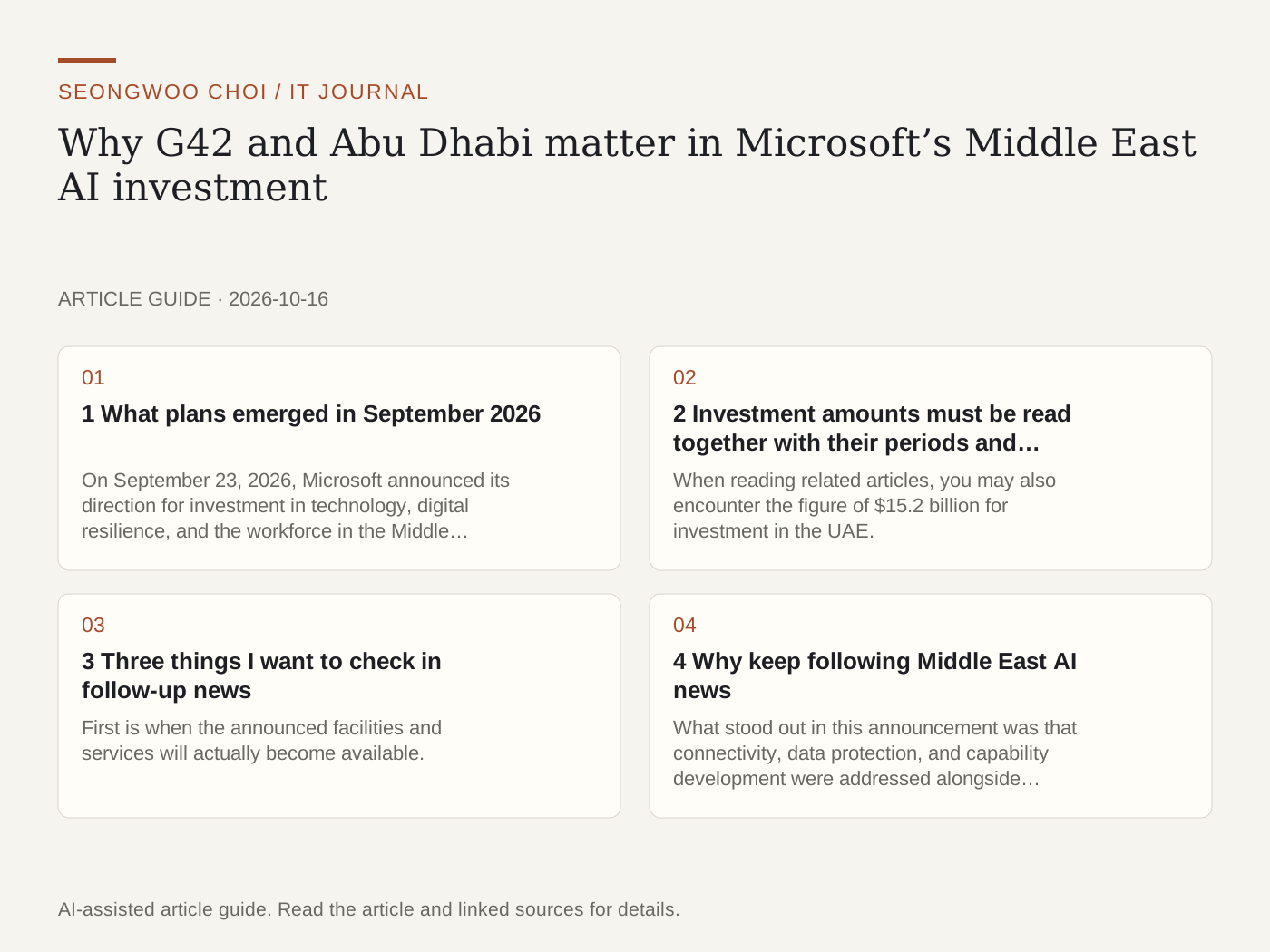
1 What plans emerged in September 2026
On September 23, 2026, Microsoft announced its direction for investment in technology, digital resilience, and the workforce in the Middle East. The initial target countries are Kuwait, Qatar, Saudi Arabia, and the United Arab Emirates.
The company explained that it plans to invest more than $10 billion in capital expenditures and operating expenses in the Middle East from the time of the announcement through 2030. It also addressed cooperation with G42 and others, cloud and AI infrastructure, connectivity, and workforce capabilities. Microsoft’s 2026 announcement (https://blogs.microsoft.com/on-the-issues/2026/09/23/microsoft-strengthens-its-commitment-to-the-middle-east-by-investing-in-technology-digital-resilience-and-people/)
2 Investment amounts must be read together with their periods and regions
When reading related articles, you may also encounter the figure of $15.2 billion for investment in the UAE. This refers to Microsoft’s investment and spending plan for the UAE from 2023 through 2029, announced in November 2025. The company explained that its planned spending for 2026–2029 was more than $7.9 billion. Original UAE investment plan (https://blogs.microsoft.com/on-the-issues/2025/11/03/microsofts-15-2-billion-usd-investment-in-the-uae/)
The two announcements cover different periods and geographic scopes and may overlap. Therefore, the $15.2 billion and $10 billion should not simply be added together and presented as a new total investment amount. We should also avoid interpreting planned spending as money that has already been spent.
3 Three things I want to check in follow-up news
First is when the announced facilities and services will actually become available. Construction commencement, completion, and service provision are separate stages, so when I look at the next updates, I want to check the date and status separately.
Second is what they will be used for. Going beyond the statement that AI infrastructure is expanding, I want to see whether actual customers and use cases are disclosed.
Third is the specific changes involving the workforce. The announcement of a training plan, the operation of training, job postings, and actual hiring are different forms of evidence. Rather than concluding that hiring or working conditions for particular roles will follow from one investment news item, it is better to verify each separately.
These are the three questions I plan to continue tracking from this announcement. I am not predicting results that have not yet been made public.
4 Why keep following Middle East AI news
What stood out in this announcement was that connectivity, data protection, and capability development were addressed alongside technological facilities. I plan to continue comparing investment figures with changes in actual operations side by side.
On the blog, I will continue distinguishing between posts that summarize official announcements and stories from daily life that I have personally verified. These are not posts conveying confidential internal company information or speaking on behalf of a particular company.
Which would you be more curious about in the Middle East AI industry: technology infrastructure or engineers’ careers?
Related article: From Aewol, Jeju Island, to Abu Dhabi (https://blog.naver.com/swchoi1994/224306231604)
Sources and original article
- blogs.microsoft.com/on-the-issues/2026/09/23/microsoft-strengthens-its-commitment-to-the-middle-east-by-investing-in-te
- blogs.microsoft.com/on-the-issues/2025/11/03/microsofts-15-2-billion-usd-investment-in-the-uae/
- blog.naver.com/swchoi1994/224306231604
Read the Korean original on Naver
This article reflects public information available when it was written. Specifications, prices and schedules can change; check the linked official documentation.
This English edition was written and translated with AI assistance, with sources provided. For errors or additional information, please request a correction. Editorial policy