AI · Software · Technology
What to Check Before Verifying OpenAI’s Navier–Stokes Proof Claim
Hello, I’m Meotjin Aewol Farmer.
OpenAI updated the mathematical research article it published on October 6, 2026, on October 15. It released new mathematical results produced by an internal frontier model in a GitHub repository and said that some proofs had been formalized in Lean code. The most notable claim is that the company solved the Navier–Stokes equations problem in fluid mechanics. However, within the scope of what I checked, I could not find evidence that independent review had been completed.
1 What was released?
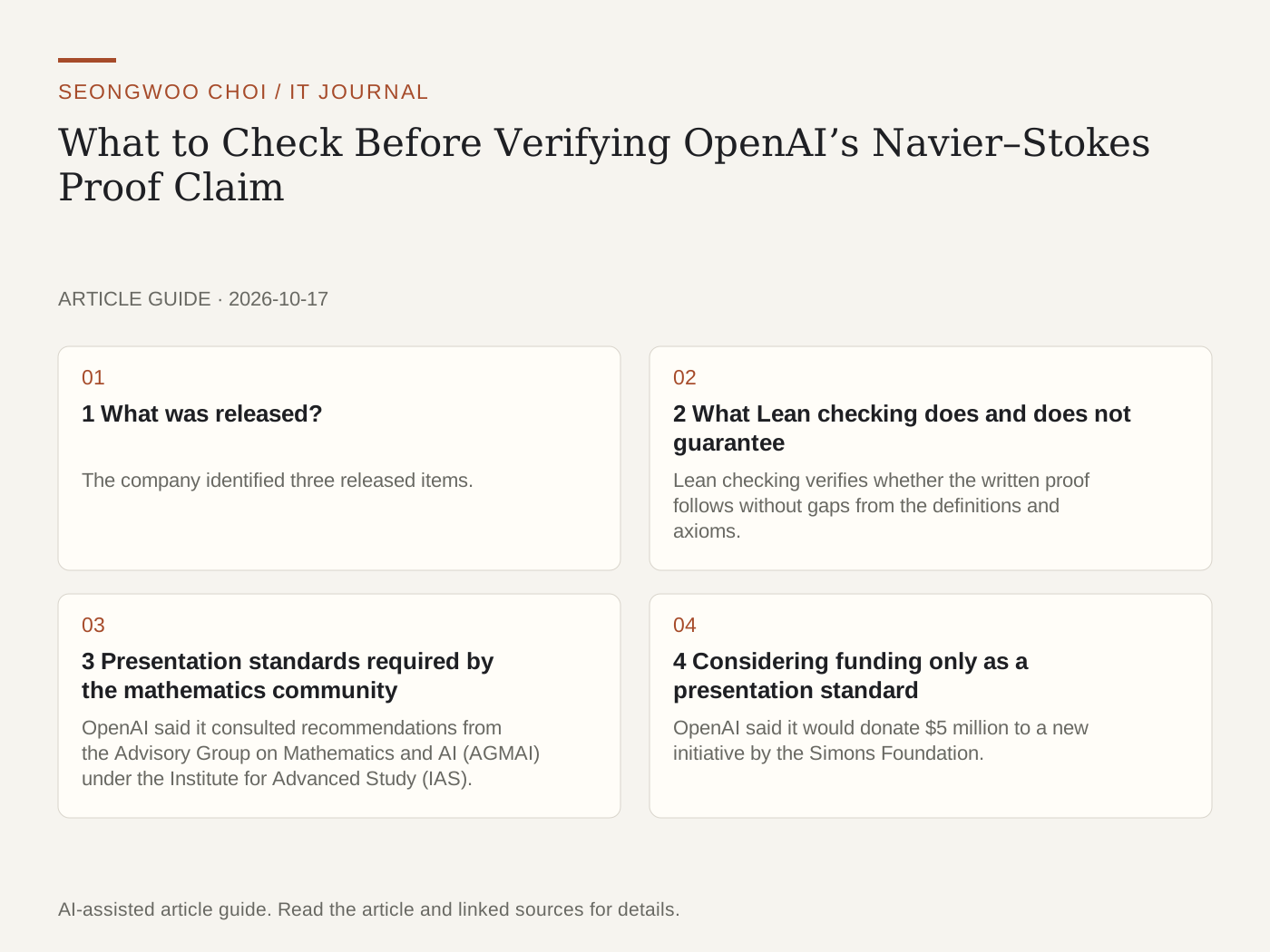
The company identified three released items. First, a GitHub repository containing new mathematical results and procedures for revising and citing papers. Second, code formalizing parts of the proofs in Lean. Lean is a programming language designed to let computers check the logical steps of proofs. Third, experimental records including 10 model-reasoning summaries, an average of about 3 hours of ChatGPT Pro compute per result, and the number of problems attempted.
2 What Lean checking does and does not guarantee
Lean checking verifies whether the written proof follows without gaps from the definitions and axioms. However, the machine does not tell you whether the formalized proposition is the same as the original question. If the definitions or assumptions differ even slightly, the check can pass while producing a solution to a different problem. Therefore, a person must read the proposition declaration in the formalization code directly.
3 Presentation standards required by the mathematics community
OpenAI said it consulted recommendations from the Advisory Group on Mathematics and AI (AGMAI) under the Institute for Advanced Study (IAS). In a document published on September 29, 2026, AGMAI presented principles for AI laboratories to disclose important mathematical results responsibly. The recommendations were created after collecting more than 600 comments.
The mathematics community values the norm that authors understand and directly verify their proofs and take responsibility for their content. Accordingly, AGMAI asked companies to stop the practice of testing difficult mathematical problems with models that have not been made public. Whether OpenAI followed these recommendations to an appropriate degree can be determined only through independent evaluation.
4 Considering funding only as a presentation standard
OpenAI said it would donate $5 million to a new initiative by the Simons Foundation. The money is intended for workshops, conferences, and special programs that help review and understand mathematical results produced by AI. It also said that researchers receiving support would be provided with models and computing resources. However, the donation is based on the company’s announcement and does not replace result verification or independent review.
5 A checklist for readers
First, distinguish the company’s claim that it “solved” the problem from the completion of independent review. Second, check the public repository directly to see which proposition the Lean code addresses. Third, see whether the experiment logs, compute usage, and number of attempted problems were disclosed together. The more material available for review, the easier it is for outside experts to examine the results.
This case prompts reflection on standards for presenting AI research. Providing verifiable records alongside a result is more likely to earn trust than presenting a single line of results. In development work as well, AI-generated code or analysis should be accompanied by execution results and test records so it can be reviewed later.
At what stage do you trust research results produced by AI?
Related article: AI agent permission management article
Sources: OpenAI, Sharing AI progress in mathematics (posted October 6, 2026; updated October 15) / OpenAI, On the Navier–Stokes Millennium Prize Problem / AGMAI, Responsible Release of AI-Generated Mathematics (September 29, 2026)
Sources and original article
- openai.com/index/sharing-ai-progress-in-mathematics/
- openai.com/index/navier-stokes-solution/
- agmai.org/general-sep29/
Read the Korean original on Naver
This article reflects public information available when it was written. Specifications, prices and schedules can change; check the linked official documentation.
This English edition was written and translated with AI assistance, with sources provided. For errors or additional information, please request a correction. Editorial policy