AI · Software · Technology
What will Siri AI on Apple TV 4K change in the living room?
Hello, I’m Meotjin Aewol Nongbu.
Apple announced the new Apple TV 4K on October 13, 2026. The key feature of this announcement is Siri AI. It presents an experience where you can find content conversationally across the entire screen. Today, I’ll summarize what is changing based on the announcement materials and what conditions still need to be confirmed.
1 What has changed?
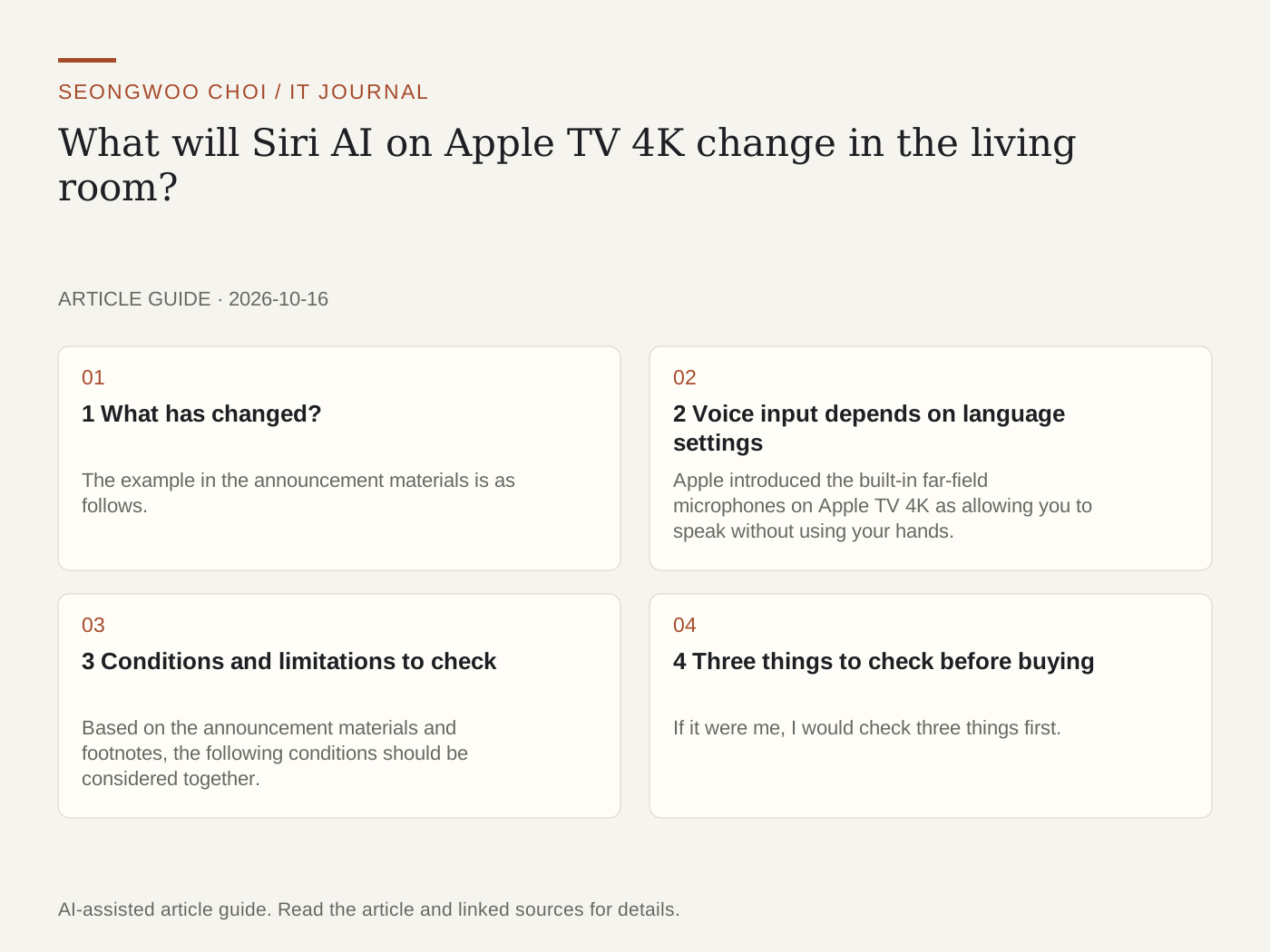
The example in the announcement materials is as follows. If you ask, “Which Apple TV shows won an Emmy this year?” poster images and follow-up recommendations such as “See more award-winning comedies” appear on the screen. You can also continue asking questions while watching, such as “Where was Pluribus filmed?” The answer is described as appearing in a small overlay that does not obscure the screen.
There are also requests that use personal context. If your iPhone supports Apple Intelligence and Siri AI is turned on, it can handle requests such as “Play the series my friend recommended.” The important point is that this feature assumes connectivity between devices.
2 Voice input depends on language settings
Apple introduced the built-in far-field microphones on Apple TV 4K as allowing you to speak without using your hands. However, a footnote in the same announcement materials says far-field microphone support is limited to cases where the default tvOS language is set to Chinese (Mandarin), Dutch, English, Finnish, French, German, Hebrew, Norwegian, or Swedish. Korean is not on this list.
Therefore, before applying the advantage of “convenient voice searching” directly to a Korean-language environment, you should first check the support scope. Based on the announcement materials alone, it is not possible to determine how or to what extent voice features will work in Korean.
3 Conditions and limitations to check
Based on the announcement materials and footnotes, the following conditions should be considered together.
First, the beta status. It is specified that Siri AI will be provided as a beta feature in tvOS 27.2.
Second, home settings. In the Home app, the owner of the home must use an iPhone or iPad that supports Apple Intelligence and have Siri AI turned on. Siri AI access is also said to be available on the second-generation Apple TV 4K and later.
Third, regional restrictions. The announcement materials state that Siri AI will not be available from the outset on iOS and iPadOS in the EU.
Fourth, usage. Apple explained that Apple Intelligence features using server models have daily usage limits, and broader access may be offered for a fee in the future.
Fifth, launch scope. According to the announcement materials, preorders have begun in the United States and 29 other countries and regions. The release date and price in Korea were not confirmed in these materials.
4 Three things to check before buying
If it were me, I would check three things first. First, whether the home owner’s device meets the Apple Intelligence and Siri AI requirements. Second, whether the language used most often is included in the voice feature support list. Third, whether sales and pricing in Korea have been officially announced. If these three conditions are not met, the practical change you feel may be limited even if the on-screen features increase.
Feature introductions contain many descriptions such as “smarter,” but these announcement materials include no figures comparing response accuracy or speed. That aspect must be checked separately after real-world usage information becomes available.
Source: Apple Newsroom press release “Apple unveils the new Apple TV 4K, supercharged by Siri AI” (October 13, 2026). This is based on the feature descriptions and footnotes and is not information confirmed through direct use. Apple Newsroom original
Do you search for TV content with the remote, or do you use your voice?
Sources and original article
Read the Korean original on Naver
This article reflects public information available when it was written. Specifications, prices and schedules can change; check the linked official documentation.
This English edition was written and translated with AI assistance, with sources provided. For errors or additional information, please request a correction. Editorial policy
Related videos and posts

Siri AI just got its own $299 home device
Apple just gave Siri AI its own $299 device. HomeView is a 7-inch home display that recognizes up to six faces, pulls personal context from your iPhone, and takes actions across apps, with Siri requests running on the A18 chip or in Private
Apple puts Siri AI on your TV for $299
Apple's new Apple TV 4K costs $299, up from $199, and runs Siri AI on an A19 chip. Three far-field mics let you talk to it without the remote; it takes actions across apps and your smart home, pulls personal context from a paired iPhone, an