AI · Software · Technology
Intel inference GPU 480GB: Calculate the memory bandwidth first
Intel disclosed technical details of its data-center inference GPU, Intel GPU D-series (codenamed Crescent Island), at OCP Global Summit on October 12. According to the company, this GPU offers up to 480GB of LPDDR5X memory, 1.5TB/s of memory bandwidth, and 1.3 petaflops of compute performance at FP8. It is a standard PCIe card with a 350W power design and air cooling. Intel said customer sampling is already underway.
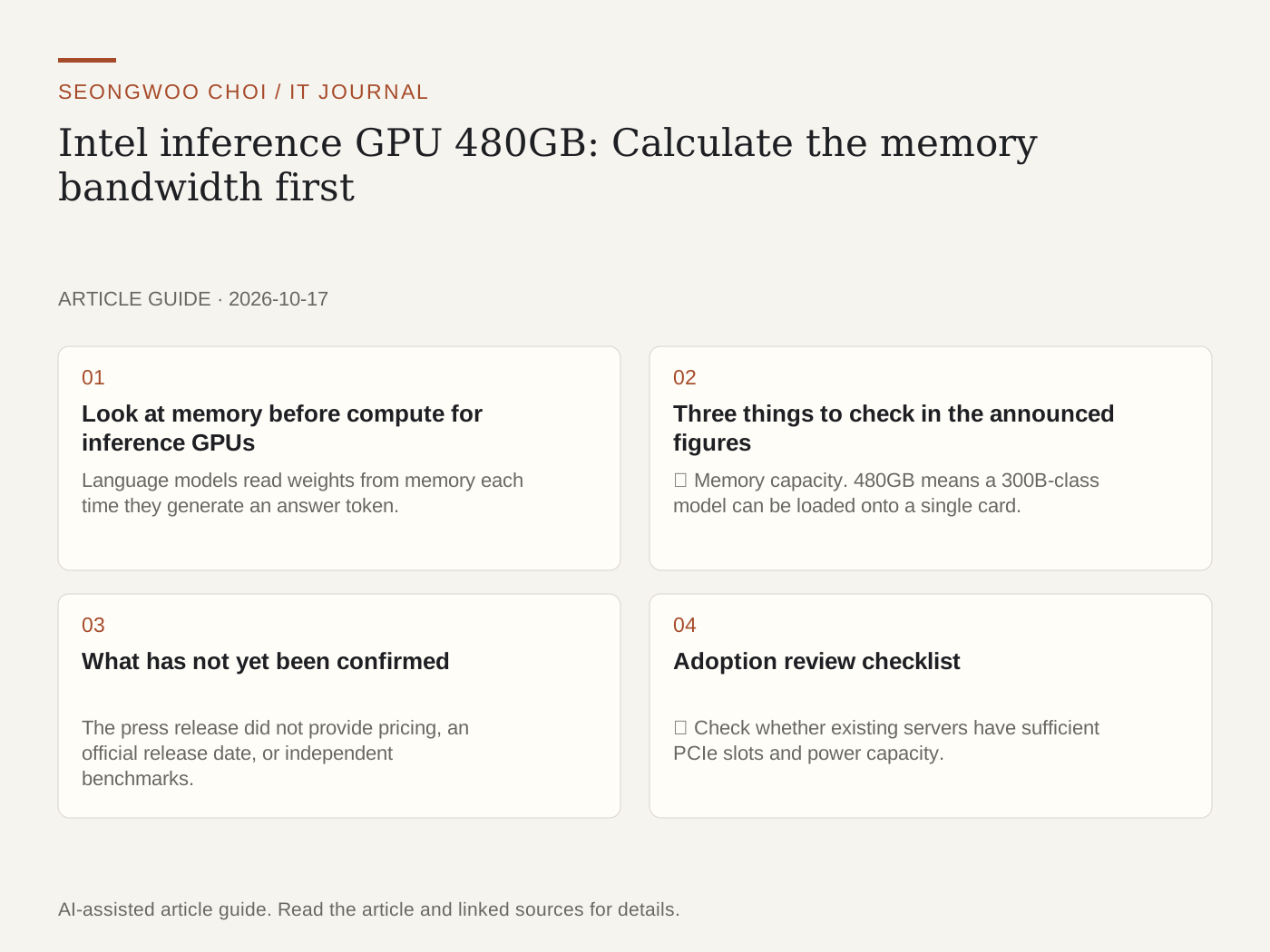
1. Look at memory before compute for inference GPUs
Language models read weights from memory each time they generate an answer token. With only one request, the compute units spend more time waiting for data, and memory bandwidth often determines the perceived speed.
Let’s do a simple calculation. If a model with 300 billion parameters is loaded onto one card in FP8, the weights alone occupy approximately 300GB. Reading them all once at 1.5TB/s takes approximately 0.2 seconds. For a single request, the theoretical upper limit is approximately 5 tokens per second. The actual value varies depending on the KV cache and software optimizations, so this figure is an assumption for explanation.
When multiple requests are processed together, the same weight reads are shared across requests, increasing overall throughput. Intel’s use of the number of agents that can be processed simultaneously at the target latency as a performance metric when describing Xeon racks follows the same context.
2. Three things to check in the announced figures
① Memory capacity. 480GB means a 300B-class model can be loaded onto a single card. Intel also said that an eight-GPU system supports models with more than 1 trillion parameters. However, this is based on the maximum configuration presented by the company.
② Compute-to-bandwidth ratio. Dividing 1.3 petaflops by 1.5TB/s gives approximately 867 FLOP/byte. The higher this ratio, the more likely the compute units are to spend time waiting for data. For workloads handling long contexts and many concurrent requests, it is worth considering available bandwidth before compute performance.
③ Installation conditions. Intel says that its standard PCIe form factor and air-cooled design allow it to be installed in existing servers without dedicated liquid cooling. The Xeon 6+ rack configuration disclosed on the same day has more than 46,000 cores per rack and total rack power of 133.45kW based on optional specifications. At the rack level, power and cooling designs must be checked first.
3. What has not yet been confirmed
The press release did not provide pricing, an official release date, or independent benchmarks. Customer sampling is different from official availability. Since no performance comparison with competing GPUs has been disclosed, it is appropriate to view this as a stage of establishing criteria for interpreting the announced figures.
4. Adoption review checklist
① Check whether existing servers have sufficient PCIe slots and power capacity.
② Calculate the required memory by adding model weights, KV cache, and the number of concurrent requests.
③ Measure throughput and latency directly using your workload rather than relying on vendor figures. If there is a sampling period, it is better used for this step.
Related article: RTX Spark Windows PC release date: What to look at first in the announced specifications
Source: Intel Newsroom, Intel Accelerates Open Infrastructure for the Agentic AI Era (based on the announcement on October 12, 2026)
Sources and original article
- www.intel.com/content/www/us/en/newsroom/news/artificial-intelligence/intel-accelerates-open-infrastructure-agent
- blog.naver.com/swchoi1994/224443349644
Read the Korean original on Naver
This article reflects public information available when it was written. Specifications, prices and schedules can change; check the linked official documentation.
This English edition was written and translated with AI assistance, with sources provided. For errors or additional information, please request a correction. Editorial policy