AI · Software · Technology
Anthropic expands its cyber verification program; defensive teams should first check their access level
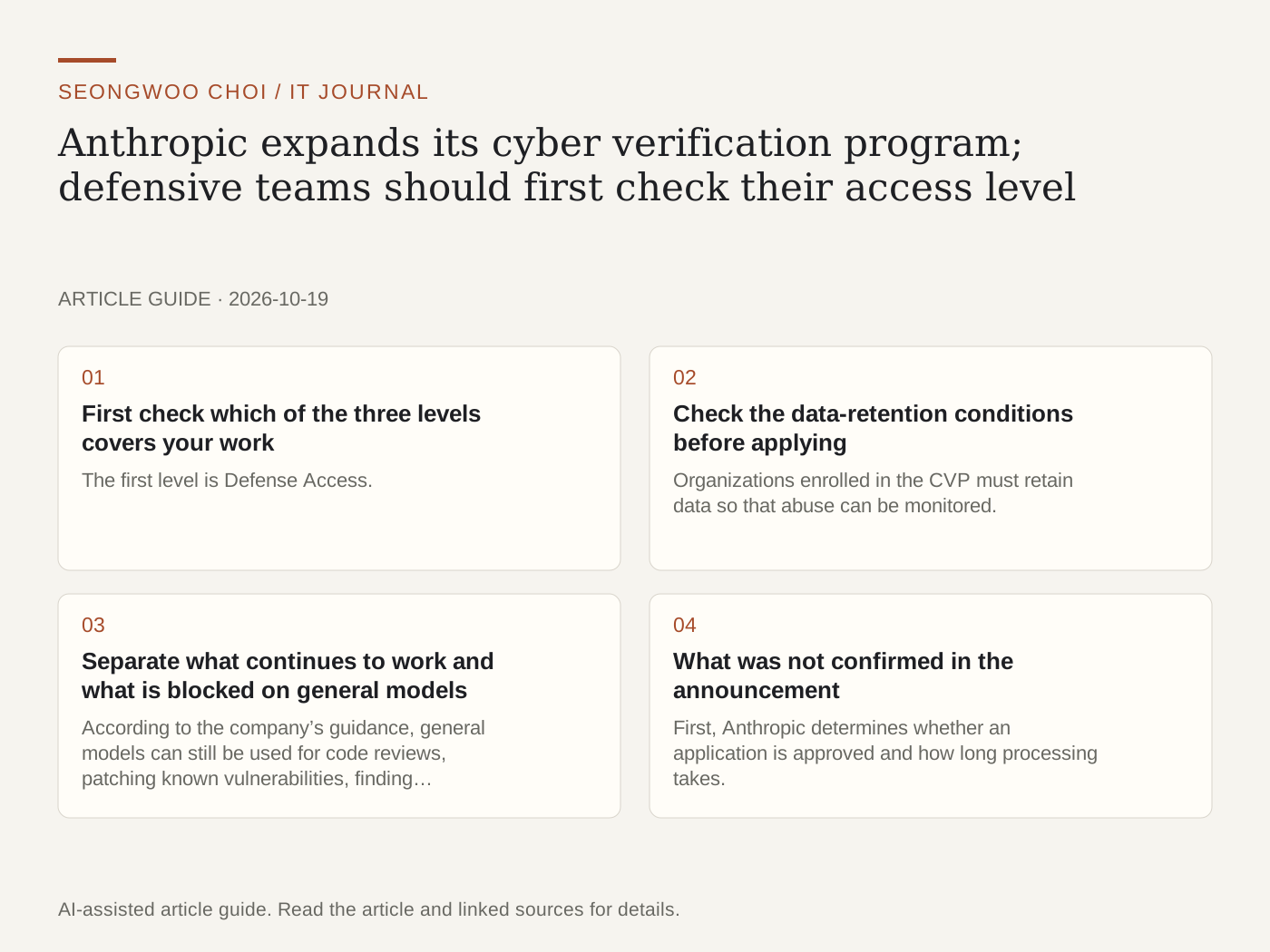
Anthropic has expanded its Cyber Verification Program (CVP). The announcement date is October 6, 2026. It offers security professionals stronger cyber capabilities with fewer blocking safeguards, while dividing access into three levels according to the scope of their work. General-public models use conservative safeguards that block most cyber tasks, so security teams should first check this access structure.
1. First check which of the three levels covers your work
The first level is Defense Access. It is intended for work that protects systems an organization owns or manages, such as security operations center (SOC) work, incident response, malware reverse engineering, and vulnerability validation. Eligible applicants include not only companies but also universities, nonprofits, small security firms, open-source maintainers, and individual researchers with a record of reporting past vulnerabilities. The company said it aims to review applications within a few days.
The second is Red Team Access. In addition to defensive work, it allows authorized penetration testing and red-team activities. In-house red teams, government red teams, and security assessment firms are eligible, while individual researchers may not apply. The review may take several weeks, and applicants will first be registered at the Defense Access level during the review period.
The third is Specialized Access. It is limited to vetted organizations that test the safety systems of infrastructure that could affect human life or markets, such as aviation operating systems, power grids, telecommunications networks, and interbank transfer infrastructure. The company explained that it conducts an in-depth, organization-by-organization review of this level together with the U.S. government. Organizations already participating in Project Glasswing will move to this level.
2. Check the data-retention conditions before applying
Organizations enrolled in the CVP must retain data so that abuse can be monitored. Organizations that operate on a zero-data-retention principle may conflict with this requirement. The company said that once Enterprise Frontier Safeguards, scheduled for release in the fall, launches, eligible organizations will be able to store data in cloud infrastructure they manage directly. Until then, it said organizations using Claude Fable 5.1 or Claude Mythos 5.1 with zero data retention can use the CVP under zero-retention conditions.
3. Separate what continues to work and what is blocked on general models
According to the company’s guidance, general models can still be used for code reviews, patching known vulnerabilities, finding vulnerabilities in one’s own source code, and triaging security alerts. By contrast, requests that could lead to actual attack activity are likely to be blocked. In the company’s published internal evaluation, all tasks tested without the CVP were blocked at the first prompt, while the Defense Access level involved intermediate blocking in 46 of 50 cases. Even for defensive work, it is safer to plan on the assumption that blocking will occur.
4. What was not confirmed in the announcement
First, Anthropic determines whether an application is approved and how long processing takes. Only targets of a few days for Defense Access and several weeks for Red Team Access were disclosed; approval is not guaranteed. Second, the result that 34 of 50 tasks were completed under Red Team Access comes from the company’s internal evaluation. We did not reproduce it independently. Third, the level-by-level chart appears as an image in the original text, so the detailed conditions must be checked directly in the original.
Related article: OpenAI to end legacy model APIs on October 23; first check the model IDs being called
Source: Anthropic, Expanding the Cyber Verification Program (October 6, 2026)
Sources and original article
Read the Korean original on Naver
This article reflects public information available when it was written. Specifications, prices and schedules can change; check the linked official documentation.
This English edition was written and translated with AI assistance, with sources provided. For errors or additional information, please request a correction. Editorial policy