AI · Software · Technology
Gemini 4 Argon officially available: What developers should check during the introductory pricing period
Hello, I’m Meotjin Aewol Nongbu.
Google announced that it will officially offer Gemini 4 Argon, a frontier model for developers, on October 13, 2026. It describes the model as primarily targeting long-running software development, enterprise knowledge work, and cyber defense. Today, we’ll organize the usage conditions, pricing, and criteria for switching that developers should check right away.
1 Where can you use it?
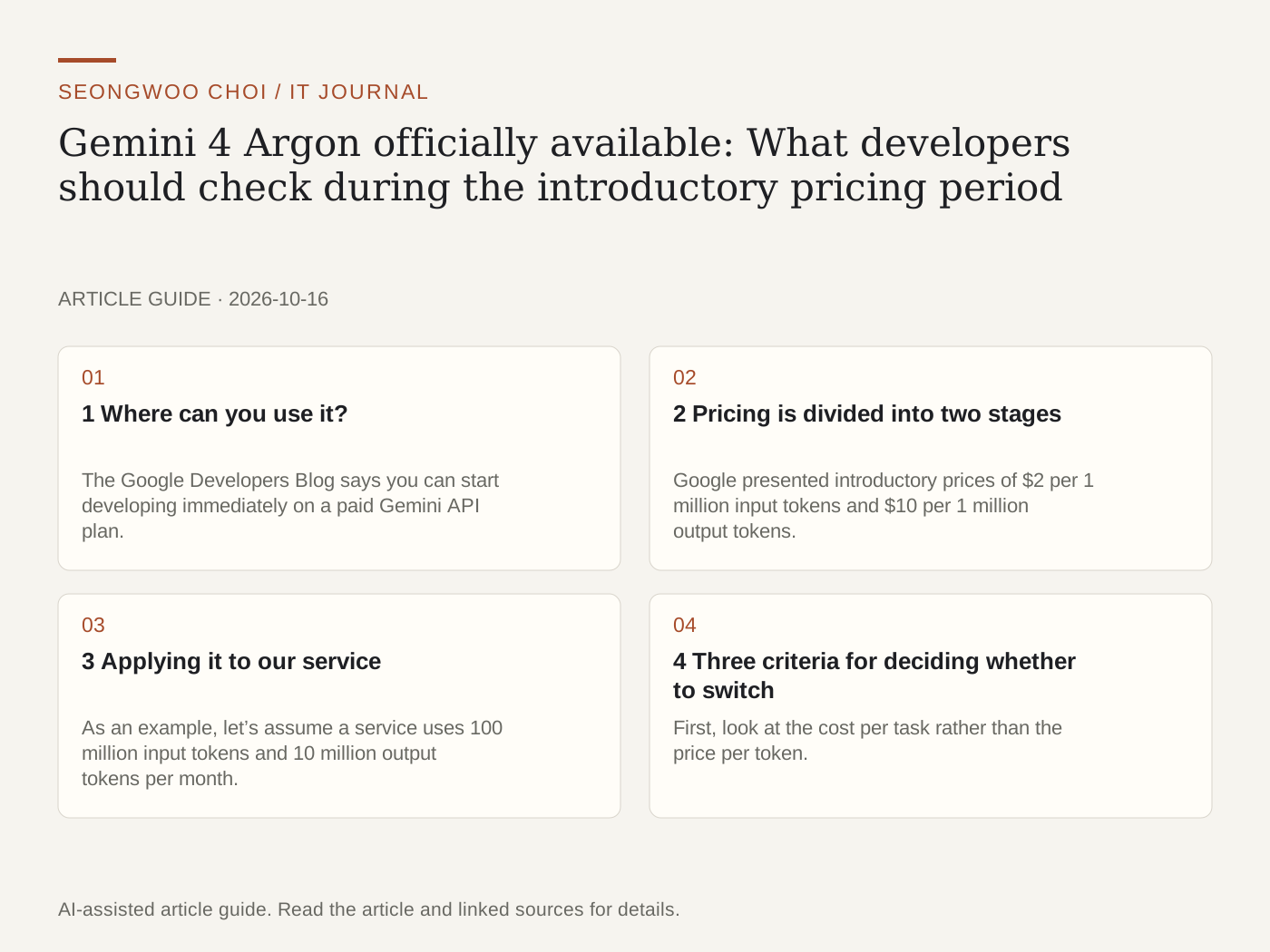
The Google Developers Blog says you can start developing immediately on a paid Gemini API plan. It is also available in Google AI Studio and Android Studio, while Google AI Ultra subscribers can try it first in AI Studio and Google Antigravity, Google’s agent development platform. Google Developers announcement
Because the announcement describes paid tiers, if you plan to try it first on a free plan, it would be a good idea to check your payment settings and usage limits first.
2 Pricing is divided into two stages
Google presented introductory prices of $2 per 1 million input tokens and $10 per 1 million output tokens. Cached input tokens receive a 95% discount. These introductory prices apply through November 30, 2026, after which the prices will be $4 for input and $20 for output, Google said. Google announcement
The important point here is that the prices double after December begins. If you set your budget based only on the introductory prices, costs could increase substantially after the end of the year.
3 Applying it to our service
As an example, let’s assume a service uses 100 million input tokens and 10 million output tokens per month. At the introductory prices, that would be $200 for input plus $100 for output, for a total of $300 per month. At the standard prices, it would be $400 for input plus $200 for output, totaling $600 per month. This is an assumption intended to demonstrate the calculation method, not actual usage.
The conversion to Korean won, VAT, exchange rates, and fees for other tools are not included in this calculation. Your budget should use the actual usage confirmed on your bill.
4 Three criteria for deciding whether to switch
First, look at the cost per task rather than the price per token. Even a higher-priced model may have a lower overall cost if it requires fewer retries. Conversely, a large model may be excessive for simple classification or short summaries.
Second, check whether your task repeatedly sends the same lengthy material. If so, the caching discount can have a significant effect.
Third, compare it using the same test set as your current model. Google’s performance descriptions are only a starting point and cannot replace results from your own codebase and documents. This article is not based on tests I ran myself.
5 Summary
Gemini 4 Argon is an option worth considering for development projects with long-running workflows. However, the current prices are introductory and will change after November 30. I recommend completing comparative tests before November and calculating the budget for after December as well.
Do you evaluate AI model costs by the price per token, or by the cost per task?
Related article: Connecting AI and external tools with MCP
Sources and original article
- blog.google/innovation-and-ai/technology/developers-tools/build-with-gemini-4-argon/
- blog.google/innovation-and-ai/models-and-research/gemini-models/introducing-gemini-4-argon/
- blog.naver.com/swchoi1994/223819780837
Read the Korean original on Naver
This article reflects public information available when it was written. Specifications, prices and schedules can change; check the linked official documentation.
This English edition was written and translated with AI assistance, with sources provided. For errors or additional information, please request a correction. Editorial policy
Related videos and posts
Gemini 4 Argon launches at half price until December
Oct 15th 2026: Google's Gemini 4 Argon is now broadly available, and its API launches at half price: $2 per million input tokens and $10 per million output tokens. On November 30 that doubles to $4 and $20. Would you build an agent on it no