AI · Software · Technology
Gemini 4 Argon launches on Google Cloud; calculate pricing from November 30, when introductory pricing ends
Google announced that its top-tier model, Gemini 4 Argon, is available on Google Cloud. The Google Cloud blog introduced Argon as a “new frontier model” and emphasized its ability to carry long tasks through to completion across multiple stages. We will examine the performance claims later; for developers, the pricing structure matters first. The same call can cost twice as much depending on when introductory pricing ends.
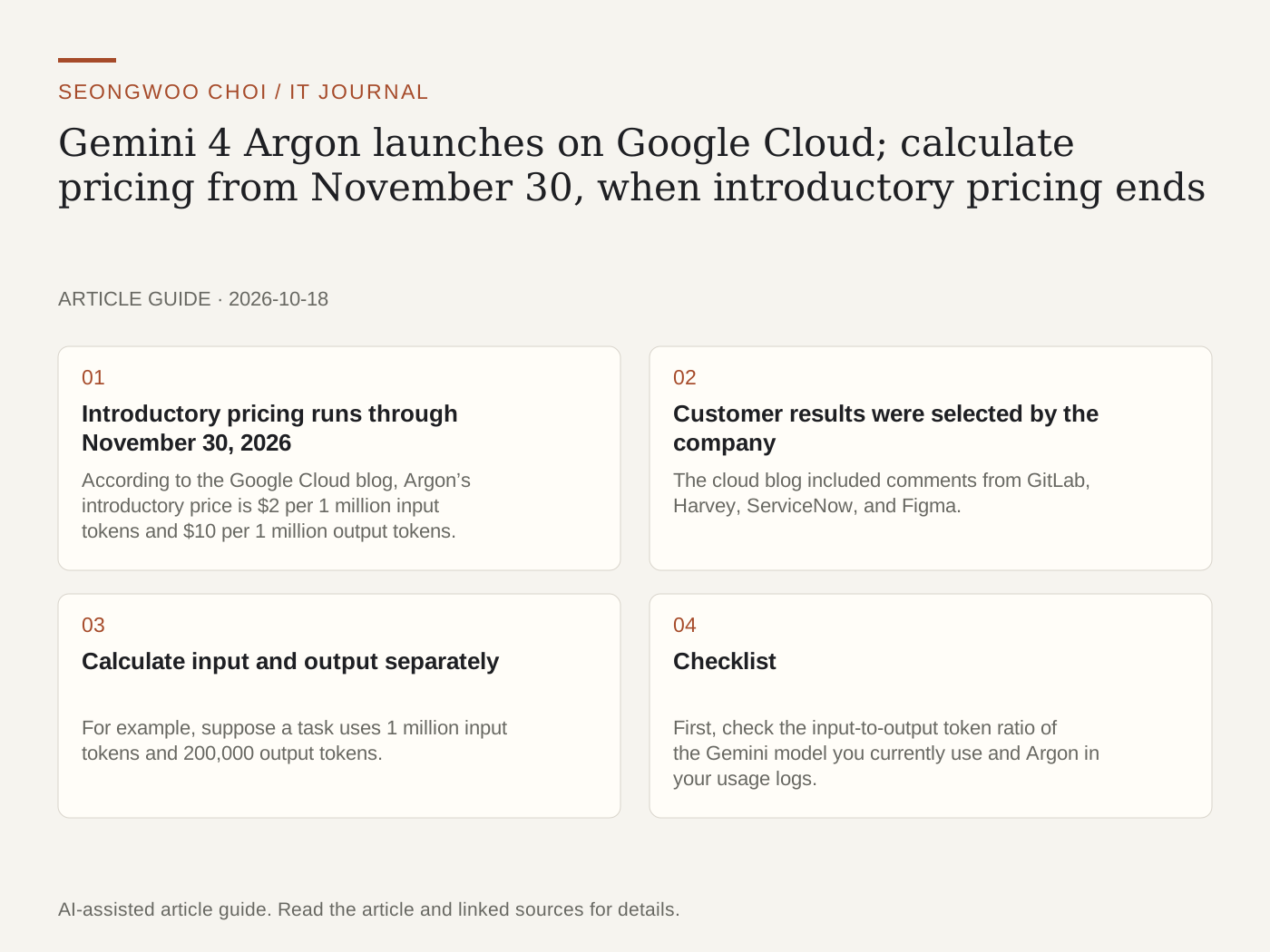
1. Introductory pricing runs through November 30, 2026
According to the Google Cloud blog, Argon’s introductory price is $2 per 1 million input tokens and $10 per 1 million output tokens. Cached input tokens are discounted by 95%, making the price $0.10 per 1 million tokens. Introductory pricing applies through November 30, 2026; afterward, the rates will be $4 per 1 million input tokens and $20 per 1 million output tokens.
2. Customer results were selected by the company
The cloud blog included comments from GitLab, Harvey, ServiceNow, and Figma. Harvey said it saw substantial improvements over Gemini 3.1 Pro in evaluations of legal agents. ServiceNow stated that its task success rate was approximately 20% higher than Gemini 3.8 Flash during the early-access period. Google’s internal examples said that the Chrome team completed a structural reorganization spanning hundreds of files in the Chromium codebase, while the ADK team reduced in-memory session preparation time for long-running sessions by 40%.
These are all results reported by the companies and customers. At the time of writing, I could not confirm figures independently reproduced by an external institution under the same conditions. Review the benchmark names and measurement conditions together, and measure them again using your own tasks.
3. Calculate input and output separately
For example, suppose a task uses 1 million input tokens and 200,000 output tokens. At the introductory price, the input costs $2 and the output costs $2, for a total of $4. Once the regular price applies, the input costs $4 and the output costs $4, for a total of $8. Actual billing may vary depending on the cache hit rate and usage conditions, so this is an illustrative example.
4. Checklist
First, check the input-to-output token ratio of the Gemini model you currently use and Argon in your usage logs. If a task produces a lot of output, the increase in the output rate will have a greater effect. Second, run comparative tests of your current model and Argon using the same prompt set. Third, check the model ID, maximum tokens, and access scope for each subscription plan in Google’s official model cards and developer documentation.
The introductory pricing conditions for the same Gemini family are summarized in the Gemini 3.8 Flash pricing article . When comparing the two models, aligning the reference date makes evaluation easier.
Source: Google Cloud blog, Gemini 4 Argon available on Google Cloud
Sources and original article
- cloud.google.com/blog/products/ai-machine-learning/gemini-4-argon-available-on-google-cloud
- blog.naver.com/swchoi1994/224444550624
Read the Korean original on Naver
This article reflects public information available when it was written. Specifications, prices and schedules can change; check the linked official documentation.
This English edition was written and translated with AI assistance, with sources provided. For errors or additional information, please request a correction. Editorial policy