AI · Software · Technology
Gemini 3.8 Flash introductory pricing set to end; check API costs from January 2027
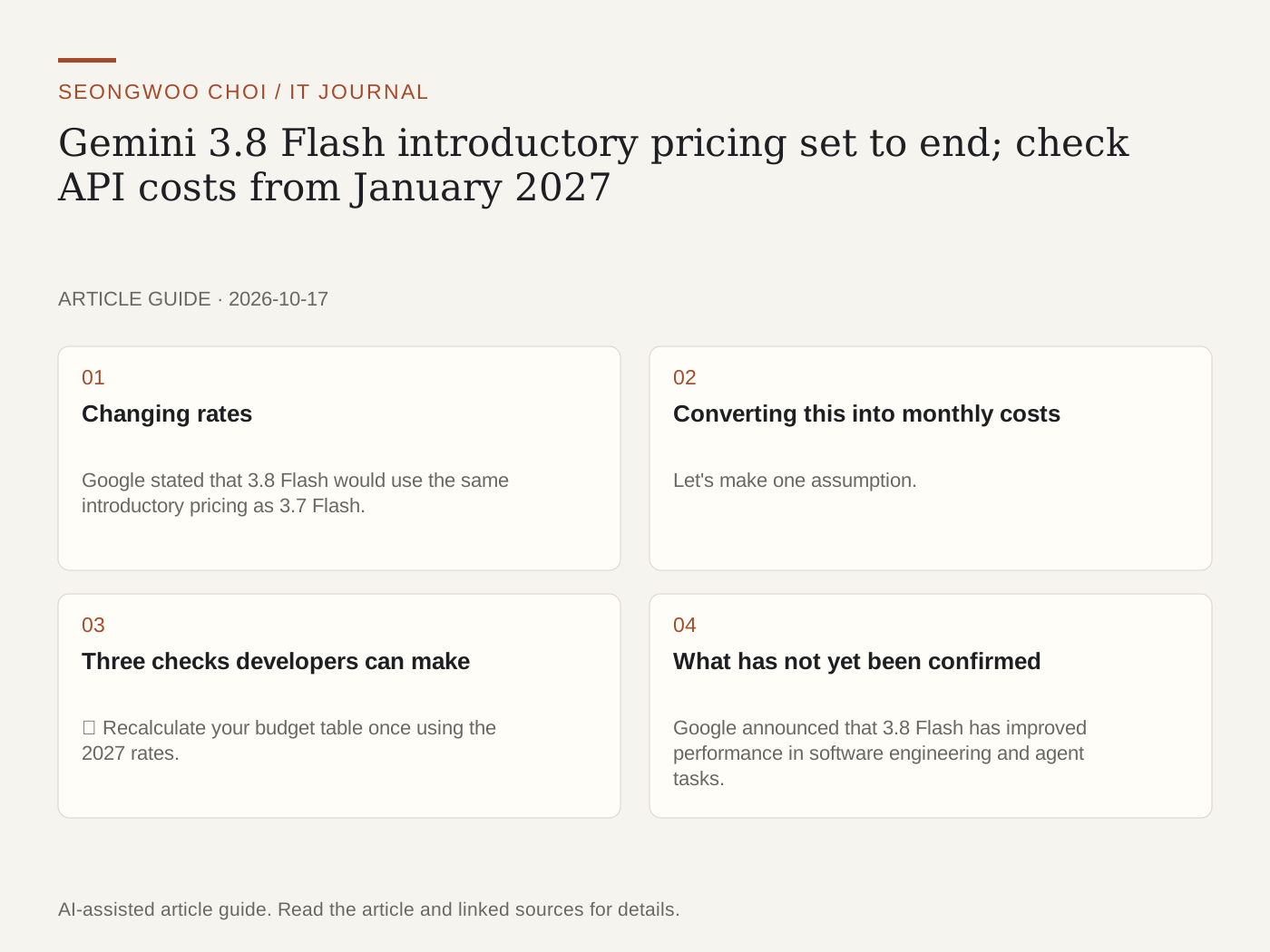
When Google launched Gemini 3.8 Flash on Sep 2nd 2026, it applied an introductory price of $0.75 per million input tokens and $3.75 per million output tokens. This pricing applies only through Dec 31st 2026, and doubles to $1.50 for input and $7.50 for output from Jan 1st 2027. If you budget API costs using only this year's rates, your figures will be off early next year.
1. Changing rates
Google stated that 3.8 Flash would use the same introductory pricing as 3.7 Flash. According to a footnote in the announcement, standard pricing after Jan 1st 2027 will be $1.50 per million input tokens and $7.50 per million output tokens. Google's pricing page also states that output pricing includes reasoning tokens (thinking tokens). The more the model reasons internally, the higher the output-side cost becomes.
2. Converting this into monthly costs
Let's make one assumption. Suppose you send 10,000 requests per month, using 2,000 input tokens and 500 output tokens per request. That results in 20 million input tokens and 5 million output tokens per month.
At the current introductory prices, the cost is $15 for input, $18.75 for output, and $33.75 total. Applying the rates from Jan 1st 2027, the cost is $30 for input, $37.50 for output, and $67.50 total. Even with the same traffic, the monthly cost exactly doubles. These figures are assumptions for explanatory purposes, not an actual bill. Actual results may vary depending on conditions such as caching, batch processing, and spending limits.
3. Three checks developers can make
① Recalculate your budget table once using the 2027 rates. If you set customer pricing or an annual budget based on introductory pricing, your margin could be wiped out at once.
② Divide models by task. Send simple requests such as classification or extraction to a cheaper model, and send only requests requiring lengthy reasoning to 3.8 Flash. In this calculation, you must account for reasoning tokens being included in output tokens.
③ Measure the “cost per successful task,” rather than the per-token price. Even at the same rate, a model that gives shorter answers and requires fewer retries may actually finish more cheaply. Instead of changing all traffic at once, the safer approach is to first send only some requests using a canary method.
4. What has not yet been confirmed
Google announced that 3.8 Flash has improved performance in software engineering and agent tasks. This is a company announcement and was not independently reproduced in this article. Public documents alone cannot confirm whether pricing will remain unchanged after 2027. It is better to check the pricing page again before finalizing your budget.
You can read the previous article on the same topic, Gemini 4 Argon officially available: What developers should check during the introductory pricing period .
Source
Google: Introducing Gemini 3.8 Flash and 3.8 Flash Cyber (Sep 2nd 2026)
Gemini Developer API pricing page
Sources and original article
- blog.google/innovation-and-ai/models-and-research/gemini-models/3-8-flash-and-3-8-flash-cyber/
- ai.google.dev/gemini-api/docs/pricing
- blog.naver.com/swchoi1994/224443282682
Read the Korean original on Naver
This article reflects public information available when it was written. Specifications, prices and schedules can change; check the linked official documentation.
This English edition was written and translated with AI assistance, with sources provided. For errors or additional information, please request a correction. Editorial policy