AI · Software · Technology
Claude Haiku 5.5 released: calculate unit costs first for high-volume tasks
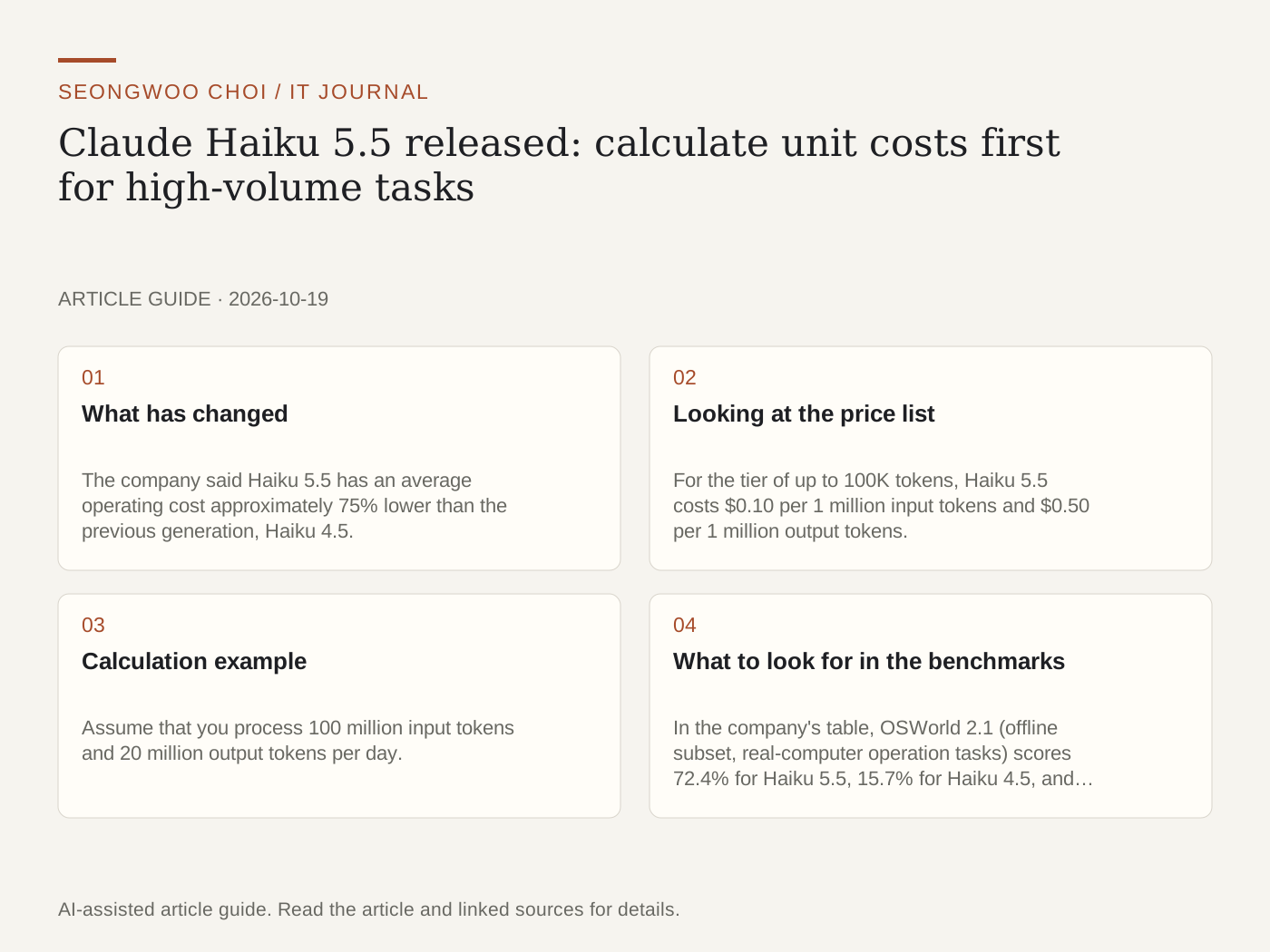
Anthropic introduced Claude Haiku 5.5 on October 7, 2026. The company described it as the fastest and lowest-priced small model in the Haiku family. It is designed for tasks with many calls, such as summarization, classification, and database queries. All figures below are values stated by the company and are not independently reproduced results.
1. What has changed
The company said Haiku 5.5 has an average operating cost approximately 75% lower than the previous generation, Haiku 4.5. It also emphasized that the model is suitable for assigning coding tasks to subagents beneath Opus 5.5 or Sonnet 5.5. In addition, it is the first Haiku-family model to include a setting for adjusting reasoning effort. This means you can choose what to prioritize between cost and quality for each call.
2. Looking at the price list
For the tier of up to 100K tokens, Haiku 5.5 costs $0.10 per 1 million input tokens and $0.50 per 1 million output tokens. Haiku 4.5 cost $1.00 for input and $5.00 for output, while Sonnet 5.5 costs $2.00 for input and $10.00 for output. Haiku 5.5's cache-read price is $0.01.
Based on list prices alone, this is about one-tenth the price of Haiku 4.5. However, the company's stated average 75% savings is based on an average across mixed real-world task configurations, so it does not equal the list-price ratio. Do not simply multiply these figures; recalculate them using your own request logs.
3. Calculation example
Assume that you process 100 million input tokens and 20 million output tokens per day. This uses only the up-to-100K-token tier and is based on list prices, excluding cache and batch discounts. In this case, Haiku 5.5 costs about $20 per day, Haiku 4.5 about $200, and Sonnet 5.5 about $400. If you repeatedly call the same system prompt, the cache-read price can significantly change the total cost. First check whether the repeated parts can be cached.
4. What to look for in the benchmarks
In the company's table, OSWorld 2.1 (offline subset, real-computer operation tasks) scores 72.4% for Haiku 5.5, 15.7% for Haiku 4.5, and 83.9% for Sonnet 5.5. Terminal-Bench 4.0 scores 39.2% for Haiku 5.5 and 70.6% for Sonnet 5.5. Rather than interpreting this as a small model catching up with a large model, it is safer to use the results to check where Haiku falls behind Sonnet. The evaluation conditions are in the company's system card.
5. What to check before adoption
① Read the migration guide before changing the model ID in use to claude-haiku-5-5. ② Compare its accuracy with Haiku 4.5 on 50–100 classification or summarization tasks. ③ Its cybersecurity safeguards are stricter than those of Haiku 4.5. Requests close to attack techniques, such as penetration testing, may be blocked, so if your work is defensive, check the Cyber Verification Program requirements. ④ The monthly API credits announced by the company are for Max and Team subscribers, and the detailed conditions must be checked on the official page.
In summary, Haiku 5.5 is worth testing first for high-volume tasks with simple structures. For complex coding or long-form reasoning, a reasonable approach is to compare it with Sonnet 5.5 or Opus 5.5 for the same tasks before deciding.
Source: Anthropic official announcement 'Introducing Claude Haiku 5.5'
Sources and original article
Read the Korean original on Naver
This article reflects public information available when it was written. Specifications, prices and schedules can change; check the linked official documentation.
This English edition was written and translated with AI assistance, with sources provided. For errors or additional information, please request a correction. Editorial policy
Related videos and posts

Anthropic's Claude lineup is now four models deep
Anthropic shipped four Claude models in six weeks: Fable 5.1 at the top, then Opus 5.5, Sonnet 5.5 and Haiku 5.5, all with a 1M-token context window. Prices run from $10/$50 per million tokens down to $0.10/$0.50, and agent builders get alw