AI · Software · Technology
DeepSeek V4.1-Flash-1017 Released: Developers Should First Check the Model Name and Search API Pricing
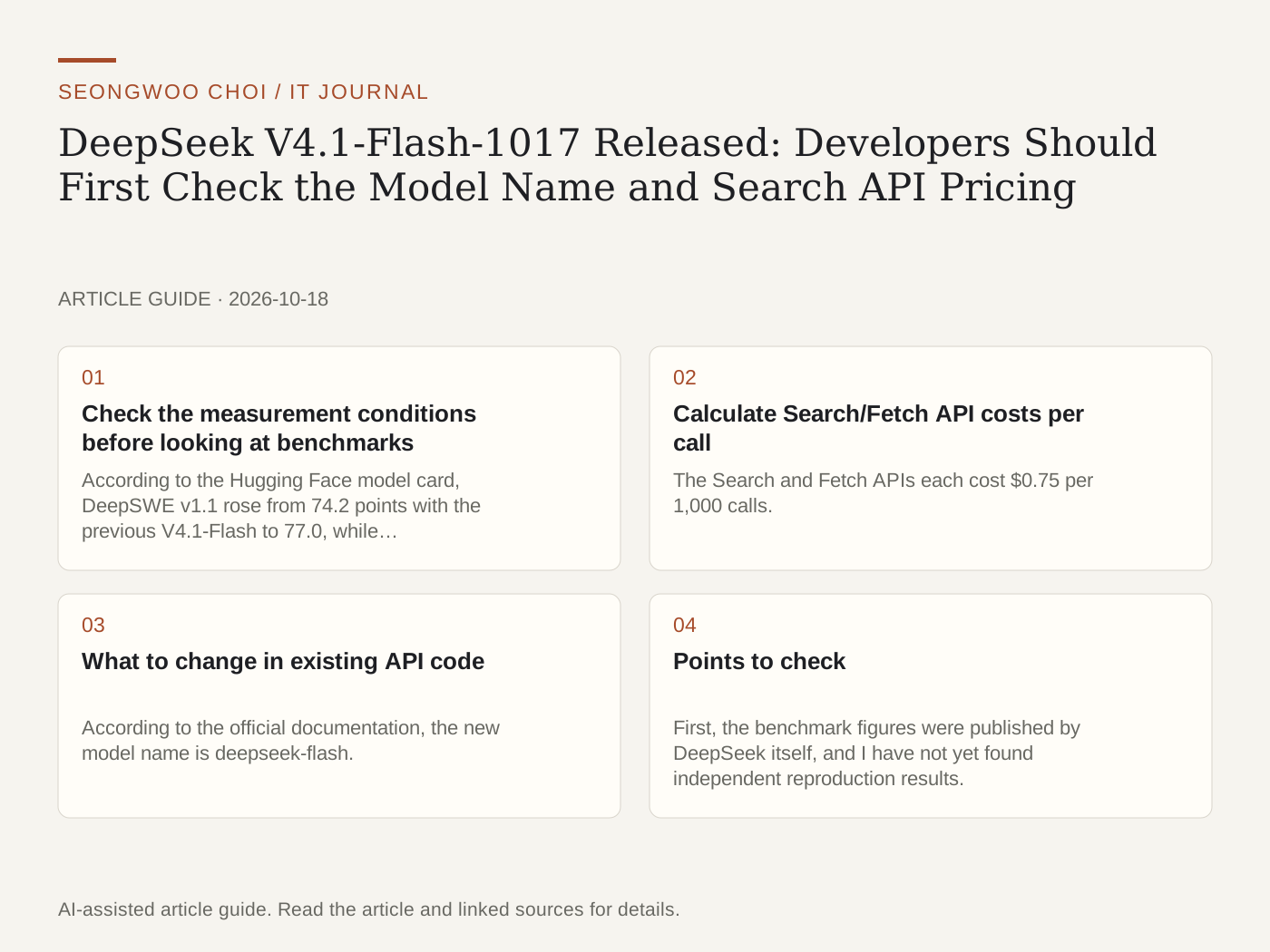
China’s DeepSeek released DeepSeek-V4.1-Flash-1017 on October 17, 2026. The company said it delivers higher performance than the previous version, with shorter task completion times and output lengths. For developers, the important points are the model name change, Search/Fetch API pricing, and how the weights are distributed. Let’s examine these three points separately.
1. Check the measurement conditions before looking at benchmarks
According to the Hugging Face model card, DeepSWE v1.1 rose from 74.2 points with the previous V4.1-Flash to 77.0, while Terminal-Bench 4.0 rose from 31.2 to 42.3 points. In the same table, Claude Opus 5 scored 74.0 on DeepSWE v1.1 and 51.8 on Terminal-Bench 4.0. Conversely, its HLE score without tools was 42.6, lower than Opus 5’s 56.3.
The company said it measured Terminal-Bench 4.0 with the Claude Code harness and DeepSWE v1.1 with the Mini-SWE-V2 harness. Since the same model can receive different scores when the harness changes, it is safest to run it once under the same conditions in your own work environment.
2. Calculate Search/Fetch API costs per call
The Search and Fetch APIs each cost $0.75 per 1,000 calls. According to the company’s announcement, Search/Fetch calls made as server-side tools from DeepSeek Harness, Claude Code, and Codex are currently free, with paid billing beginning at 16:00 UTC on October 31, 2026.
For example, if an agent uses 1,000 searches and 1,000 fetches, the base price is $1.50. Since the actual cost depends on how many times the agent repeats searches, it is advisable to start by counting the calls in the test logs.
3. What to change in existing API code
According to the official documentation, the new model name is deepseek-flash. The existing names deepseek-v4-flash and deepseek-v4-flash-vision-exp are still accepted, but those models have been retired; requests are processed by V4.1-Flash and billed at the Flash price. Existing code will work for now, but it is better to change the model name in the long term.
The weights are available under the MIT license from Hugging Face and ModelScope. The context window is 1 million tokens, and the recommended sampling settings are temperature 1.0 and top_p 1.0. However, this distribution does not include a Jinja chat template. Instead, use the Python reference implementation in the encoding folder; the deepseek-recipe library has also been released for production use.
4. Points to check
First, the benchmark figures were published by DeepSeek itself, and I have not yet found independent reproduction results. Second, the pricing and free period are based on the current announcement, so check the official documentation again before billing begins. Third, the chart in this article is an explanatory figure based on model card figures, not the result of direct experiments.
Related article: Intel Inference GPU 480GB: Calculate the Memory Bandwidth First
Sources: Official DeepSeek API announcement, October 17, 2026 / DeepSeek-V4.1-Flash-1017 model card
Sources and original article
- api-docs.deepseek.com/news/news261017
- huggingface.co/deepseek-ai/DeepSeek-V4.1-Flash-1017
- blog.naver.com/swchoi1994/224444693710
Read the Korean original on Naver
This article reflects public information available when it was written. Specifications, prices and schedules can change; check the linked official documentation.
This English edition was written and translated with AI assistance, with sources provided. For errors or additional information, please request a correction. Editorial policy