AI · Software · Technology
EmbeddingGemma 2 released: calculate first whether to reduce search index dimensions from 768
Google DeepMind released the EmbeddingGemma 2 embedding model on October 6, 2026. Based on Gemma 4, it is an open-weight model licensed under Apache 2.0. Because it places text, code, images, video, and audio in one 768-dimensional vector space, multiple formats can be searched together in the same search index. Developers building search functions must first decide two things before costs can be calculated: which encoders to deploy and how many dimensions to use for storing the vectors.
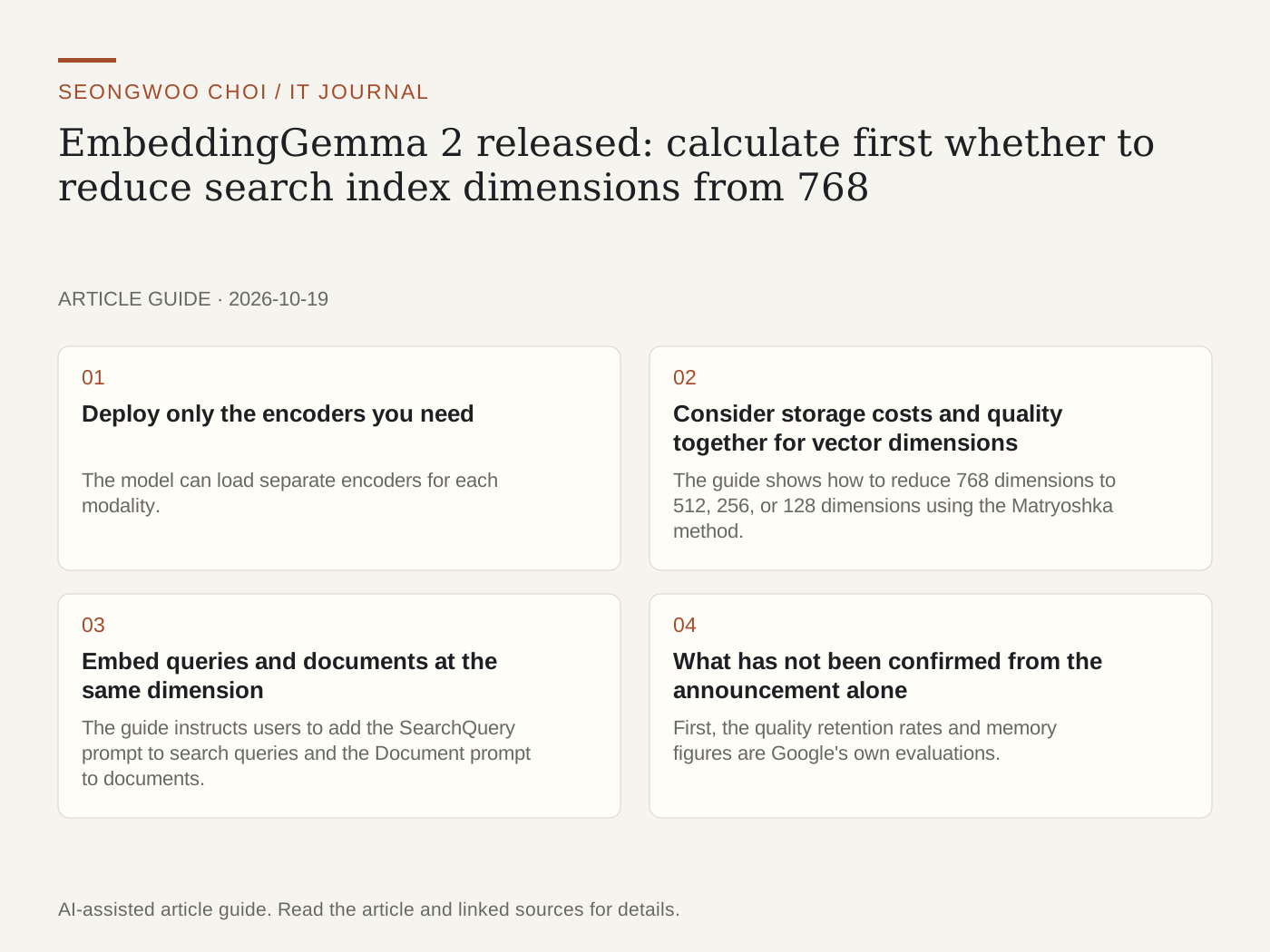
1. Deploy only the encoders you need
The model can load separate encoders for each modality. Text and code alone require 270M parameters; adding images requires 440M, adding audio requires 570M, and using everything requires 740M. According to the official developer guide, adding encoders later does not require recalculating embeddings that have already been computed. Google stated that, on a Pixel 11 Pro, text-only weights use approximately 191MB of active memory, while the full multimodal model uses approximately 567MB. These figures are measurements by the company.
2. Consider storage costs and quality together for vector dimensions
The guide shows how to reduce 768 dimensions to 512, 256, or 128 dimensions using the Matryoshka method. If 1 million vectors are stored in bf16 (2 bytes per vector dimension), 768 dimensions require approximately 1.5GB, while 128 dimensions require approximately 250MB. Google reported the following quality retention rates: 256 dimensions retain most of the original quality for text and code and approximately 95% for image, video, and audio search. 128 dimensions retain approximately 90% for text and code and approximately 75% for multimodal search. Storage is reduced to one-third at 256 dimensions and one-sixth at 128 dimensions.
The Google guide recommends 128 dimensions for large text-focused indexes or first-stage shortlisting, and explains that they should be validated on actual data before being used for multimodal queries.
3. Embed queries and documents at the same dimension
The guide instructs users to add the SearchQuery prompt to search queries and the Document prompt to documents. The truncation dimension (truncate_dim) must also be the same for queries and documents. Vectors with different dimensions cannot be compared, so changing the dimension after creating an index breaks search. Installation requires sentence-transformers 6.1.0 or later and the command pip install -U sentence-transformers[image,audio,video] transformers; the model ID is google/embeddinggemma-2.
4. What has not been confirmed from the announcement alone
First, the quality retention rates and memory figures are Google's own evaluations. We did not reproduce them separately. Second, zero-shot intent classification (intent routing) was introduced as a demonstration, but we could not confirm its accuracy figures. Third, the ML Kit service for Android was described at the time of the announcement only as coming within a few weeks. We did not confirm whether it is actually available now.
Related article: Gemini API preview models marked to end on October 22 and 23; check the call IDs and replacement models first
Sources: Google Developers Blog, EmbeddingGemma 2: The Developer Guide (October 6, 2026) , Google AI Edge, Bring multimodal semantic search to the edge with EmbeddingGemma 2 (October 6, 2026)
Sources and original article
- developers.googleblog.com/embeddinggemma-2-the-developer-guide/
- developers.googleblog.com/google-ai-edge-with-embeddinggemma-2/
- blog.naver.com/swchoi1994/224446093664
Read the Korean original on Naver
This article reflects public information available when it was written. Specifications, prices and schedules can change; check the linked official documentation.
This English edition was written and translated with AI assistance, with sources provided. For errors or additional information, please request a correction. Editorial policy