AI · Software · Technology
Meta unveils Muse Wonder; calculate API costs starting at $4 for input and $20 for output
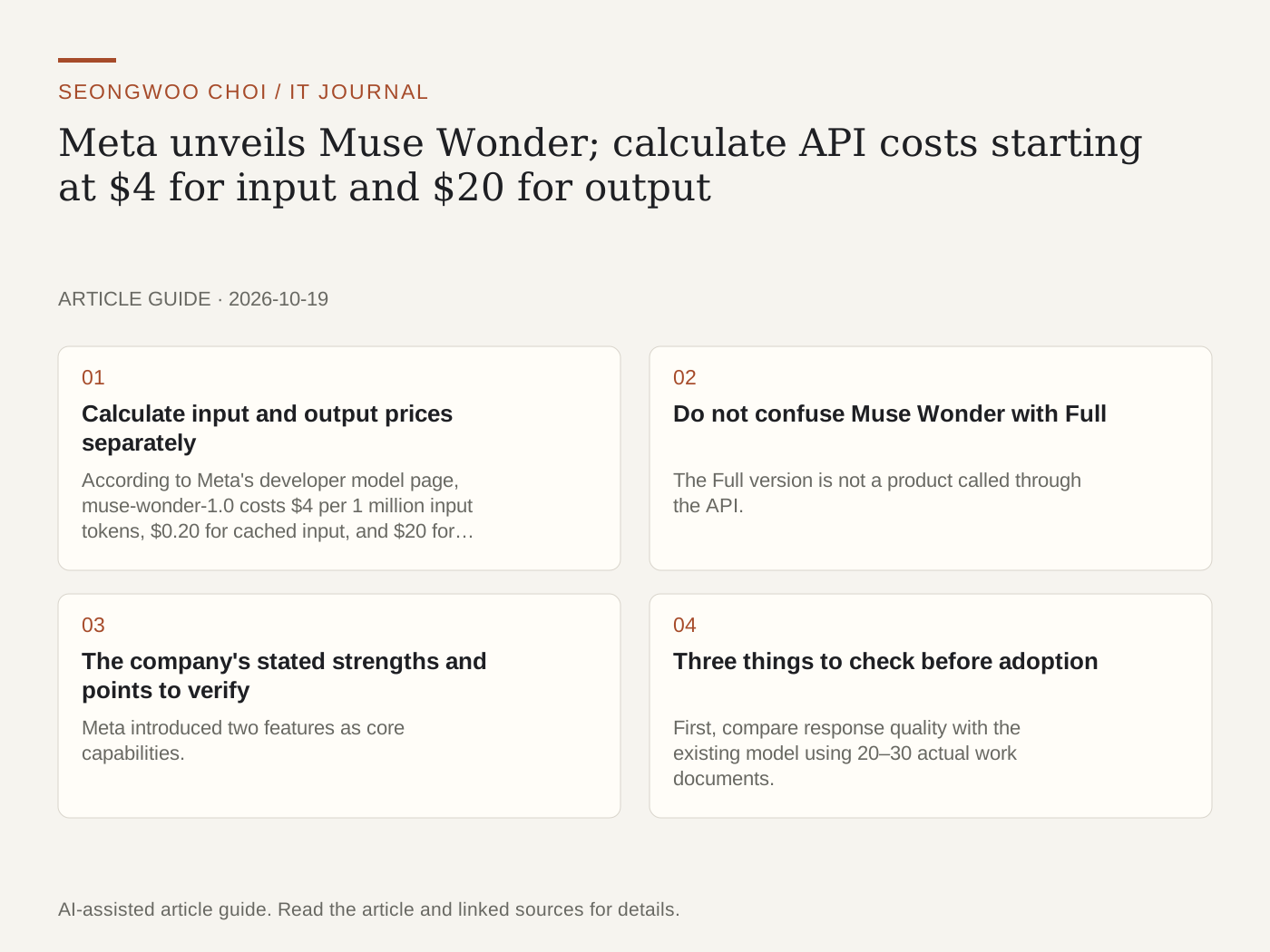
Meta unveiled the new Muse Wonder model series on October 12. The basic version, Muse Wonder (API identifier muse-wonder-1.0), is available through the Meta Model API and Muse Code. The higher-end Muse Wonder Full is available only to Muse Code subscribers. For developers, checking call costs and access routes before performance claims is the proper order.
1. Calculate input and output prices separately
According to Meta's developer model page, muse-wonder-1.0 costs $4 per 1 million input tokens, $0.20 for cached input, and $20 for output. Its context window is 1,048,576 tokens. Because the output price is five times the input price, the cost structures differ greatly between tasks that read long documents and answer briefly and tasks that generate long code. Set the response length limit (max_tokens), and first check the average output tokens in your call logs.
Also check how much existing code needs to be changed. Meta says you can point an OpenAI SDK-compatible client to the Meta Model API address. However, you should verify the model name, tool-calling format, and streaming responses once with actual requests. Having a compatible interface and getting the same results are different matters.
2. Do not confuse Muse Wonder with Full
The Full version is not a product called through the API. Meta's developer page directs users to use this model within Muse Code subscription plans. The plans include $50 per month (Power Usage) and $200 per month (Maximum Usage). If you plan to integrate it into your own service, you should design around the API version's pricing and latency; do not use the Full version's performance figures directly in cost calculations.
3. The company's stated strengths and points to verify
Meta introduced two features as core capabilities. Active Memory remembers important context between conversations and retrieves it as needed for the task. Active Focus tries different approaches for difficult tasks, recovers from errors, and asks for confirmation before important actions. Meta also claims it is top-level in the legal, financial, and health sectors and in long-term software work.
However, the evaluation names and scores, such as FocusBench and SWE-Marathon, were designed and announced by Meta. Until evaluations from independent organizations are available, they should be read as company claims. The benchmark figures appear only in an image of the original table, so they were not reproduced in this article.
4. Three things to check before adoption
First, compare response quality with the existing model using 20–30 actual work documents. Second, calculate how many input tokens accumulate when using the 1M context, together with the cache hit rate. Third, if you enable the memory feature, decide first what personal information remains between conversations and how it can be deleted. Meta said it trained the model not to share personal information without permission, but also said the full report containing additional safety evaluations is still being prepared.
Related article: OpenAI legacy model API ending October 23; check the IDs of models currently being called first
Sources: Meta research blog Muse Wonder · Meta developer model page · Meta Newsroom original
Sources and original article
- research.meta.ai/blog/muse-wonder
- dev.meta.ai/models/muse-wonder
- about.fb.com/news/2026/10/introducing-muse-wonder-models/
Read the Korean original on Naver
This article reflects public information available when it was written. Specifications, prices and schedules can change; check the linked official documentation.
This English edition was written and translated with AI assistance, with sources provided. For errors or additional information, please request a correction. Editorial policy
Related videos and posts

Meta's first frontier model wants to remember you
Meta released Muse Wonder and Muse Wonder Full, its first frontier models, built for agents that remember you across conversations and keep working when a task gets hard. Wonder is live in the Meta Model API and Muse Code; CNBC reports Muse