AI · Software · Technology
GPT-6.1 Sol cached-input pricing is $0.10 per 1 million tokens: calculate repeat-call costs first
According to OpenAI’s official pricing, GPT-6.1 Sol costs $2 per 1 million standard input tokens and $0.10 for input read from the cache. For services that repeatedly send the same prompt prefix, the cache hit rate can significantly change monthly costs. The calculations below are examples based solely on pricing figures checked on October 20, 2026. Actual charges may vary depending on request structure and cache-eligibility conditions.
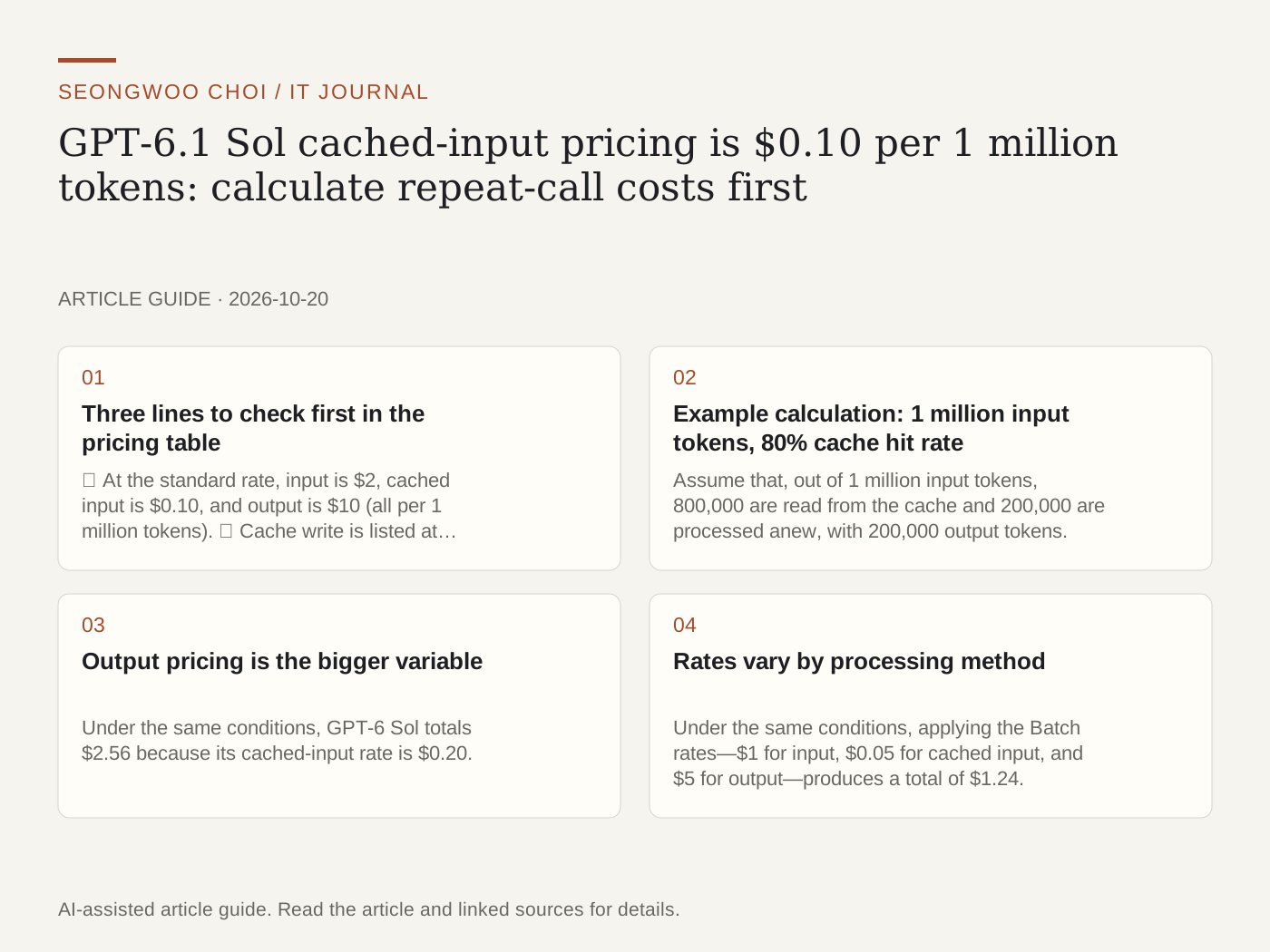
1. Three lines to check first in the pricing table
① At the standard rate, input is $2, cached input is $0.10, and output is $10 (all per 1 million tokens). ② Cache write is listed at $2.50, higher than the input rate. If you send the same content only once and do not read it again, caching costs more. ③ For long contexts exceeding 272K tokens, the rates increase to $4 for input, $0.20 for cached input, and $15 for output.
2. Example calculation: 1 million input tokens, 80% cache hit rate
Assume that, out of 1 million input tokens, 800,000 are read from the cache and 200,000 are processed anew, with 200,000 output tokens. Without caching, the total is $4.00: $2.00 for input plus $2.00 for output. With caching, the total is $2.48: $0.40 for new input, $0.08 for cached input, and $2.00 for output. Under this assumption, the cost decreases by approximately 38%.
3. Output pricing is the bigger variable
Under the same conditions, GPT-6 Sol totals $2.56 because its cached-input rate is $0.20. Its cached-input rate is twice that of GPT-6.1 Sol, but the difference is only $0.08, or approximately 3%. For tasks with many output tokens, the $10 output rate has a greater effect on cost. When choosing a model, do not look only at the cache rate; measure output length as well.
4. Rates vary by processing method
Under the same conditions, applying the Batch rates—$1 for input, $0.05 for cached input, and $5 for output—produces a total of $1.24. Using the Fast rates—$4 for input and $20 for output—produces $4.96, nearly twice as much. Separate calls that require fast responses from tasks that can wait, and calculate their rates separately. Whether batch processing suits real-time responses must be checked separately.
5. What to do now
① Check the proportion of input tokens read from the cache in your call logs. Without this value, the calculations above cannot be adapted to actual charges. ② Increase the cache hit rate by keeping recurring prefixes, such as system instructions and tool definitions, fixed. ③ Check whether the model ID is gpt-6.1-sol or gpt-6-sol. The two models have the same input and output rates, but different cached-input rates.
In summary, you must consider both the cache hit rate and output length. Data residency endpoints carry a 10% surcharge according to the pricing table, so check the region settings as well. Prices are based on the list prices published by OpenAI and do not include contractual discounts.
Source: OpenAI API pricing, developers.openai.com/api/docs/pricing (checked October 20, 2026) / OpenAI DevDay 2026 recap
Sources and original article
Read the Korean original on Naver
This article reflects public information available when it was written. Specifications, prices and schedules can change; check the linked official documentation.
This English edition was written and translated with AI assistance, with sources provided. For errors or additional information, please request a correction. Editorial policy
Related videos and posts

OpenAI DevDay: 20+ launches for builders in one day
OpenAI's DevDay 2026 shipped 20+ developer updates in one keynote: GPT-6.1 Sol at one-fifth of Astra's price, an Ultrafast speed tier, computer use in the Agents API, Codex in the cloud, plugin sidebars, Sign in with ChatGPT and a $500 Pro