AI · Software · Technology
Comparing Korean emails from ChatGPT, Claude, and Gemini: How to test them directly under the same conditions
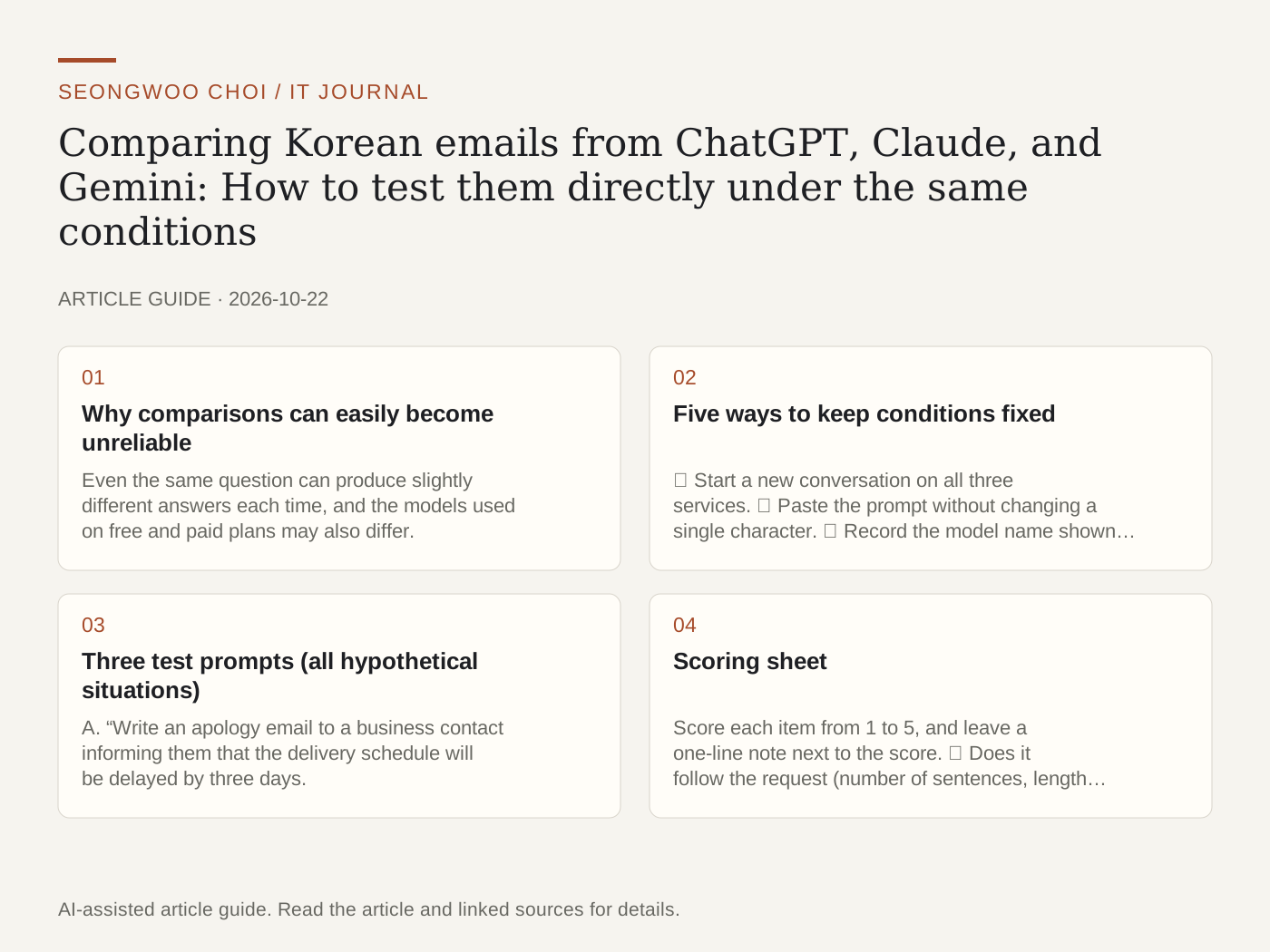
First, a disclosure: This article is not the result of actually running all three services. As of October 20, 2026, when this article was written, Gemini was inaccessible in this blog’s writing environment, so the three models could not be directly compared under the same conditions. Rather than ranking them, I provide a testing method and scoring sheet that readers can use to compare them fairly with their own accounts in a short time. Once all three services become available, I plan to organize the actual results separately.
1. Why comparisons can easily become unreliable
Even the same question can produce slightly different answers each time, and the models used on free and paid plans may also differ. Since model names and default models frequently change from one service to another, saying “which one is better” is difficult to substantiate without the date and model name. Cases in which model configurations differ by plan were covered in the GPT-6 ChatGPT expansion article .
2. Five ways to keep conditions fixed
① Start a new conversation on all three services. ② Paste the prompt without changing a single character. ③ Record the model name shown on screen and the date first. ④ Run the same prompt three times on each service. ⑤ Save the first results exactly as they are, without revising them, and then score them.
3. Three test prompts (all hypothetical situations)
A. “Write an apology email to a business contact informing them that the delivery schedule will be delayed by three days. Use honorific language, keep it to six sentences or fewer, and set the new delivery date to [date].”
B. “Write an email politely declining a quotation because the price is not right. We want to maintain the relationship, so mention a future opportunity. Around 200 characters.”
C. “Write an email requesting a meeting with a professor whom I am contacting for the first time. Leave the department and name as [blank], do not make anything up, and leave the blanks as they are.”
Prompt C is intended to test whether the model invents information it does not know. Deduct points if it fills the blanks with plausible names.
4. Scoring sheet
Score each item from 1 to 5, and leave a one-line note next to the score. ① Does it follow the request (number of sentences, length, and date)? ② Are the honorifics and level of formality appropriate to the situation? ③ Does it avoid sounding like a translation? ④ Does it avoid inventing nonexistent facts? ⑤ Is it ready to send as is? The image below is a blank version of this scoring sheet.
5. How to record the results
If you write “service / model name shown on screen / date / prompt letter / run number / scores by item” on one line, you can review it later. Look first at whether points were deducted for item ④, rather than at the total score. Once an email is sent, it cannot be taken back.
6. How to interpret the results
If the score varies widely among the three runs, that means the service is inconsistent even with the same request. If the averages are similar, choose based on plan limits and price. Whichever service you use, a person must always read the email before sending it and personally verify the recipient’s name, date, and amount.
In summary, the four key points are recording the model name and date, keeping the prompt fixed, running it three times, and deducting points for fabrication. The habit of checking the call settings when model names change was also covered in the Claude Haiku 5.5 publication article and the Gemini Gems discontinuation schedule article .
Sources and original article
Read the Korean original on Naver
This article reflects public information available when it was written. Specifications, prices and schedules can change; check the linked official documentation.
This English edition was written and translated with AI assistance, with sources provided. For errors or additional information, please request a correction. Editorial policy